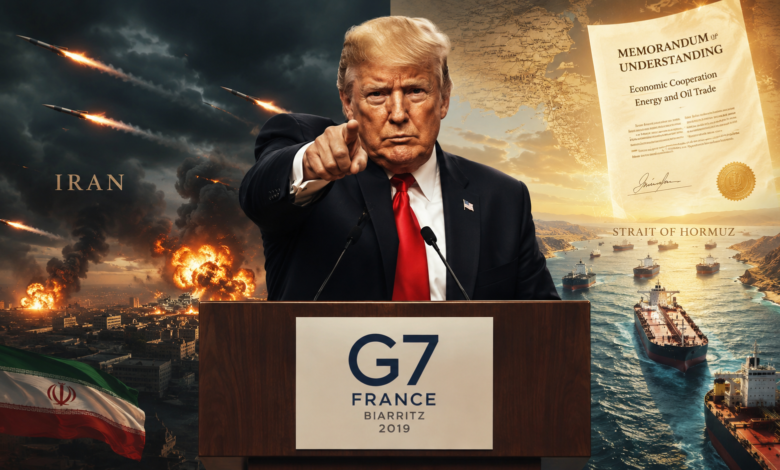
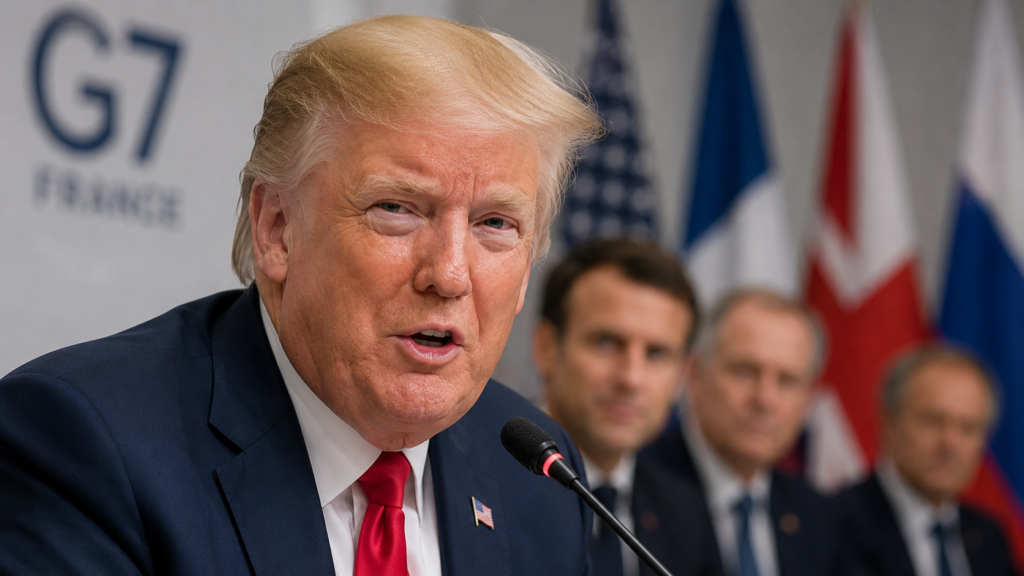
In a moment that captured headlines worldwide, Donald Trump drops big bombshell during high-stakes discussions surrounding the United States and Iran. Speaking on the sidelines of the G7 summit in Évian-les-Bains, France, in mid-June 2026, the president made it clear that the recently negotiated memorandum of understanding with Tehran was far from a done deal. He warned that if Iran failed to “behave,” American forces would resume military action with striking force. The blunt language, delivered while meeting Egyptian President Abdel Fattah el-Sisi, immediately dominated news cycles and social media feeds.
This was not careful diplomatic phrasing. Trump stated that the agreement represented only a memorandum of understanding and that the United States retained the right to return to “dropping bombs right smack in the middle of their head” if conditions were not met. The remarks came as markets reacted positively to signs of de-escalation, oil prices hovered near multi-month lows, and diplomats scrambled to interpret the exact meaning of the framework. For many observers, the episode exemplified the unpredictable style that has defined Trump’s second term in office. Donald Trump drops big bombshell moments like this have become a recurring feature of his presidency, forcing allies, adversaries, and analysts to constantly recalibrate their expectations.
The broader context involves months of intense military engagement between the United States and Iran, followed by rapid negotiations that produced an interim accord. That document aimed to halt hostilities, reopen the Strait of Hormuz, and open a 60-day window for deeper talks on nuclear issues and sanctions. Yet Trump’s public comments underscored that compliance would be closely monitored and that military options remained firmly on the table. The combination of tough rhetoric and tentative diplomacy has left the international community debating whether this approach strengthens American leverage or injects unnecessary volatility into an already fragile situation.
The Exact Words That Sparked Global Attention
When Donald Trump drops big bombshell statements, the language is rarely ambiguous. At the G7 gathering he described the Iran arrangement as temporary and conditional. “It’s a memorandum of understanding, and if I don’t like it, we’ll go back to shooting at them, dropping bombs on their heads,” he said. He repeated the warning for emphasis, noting that bad behavior would trigger a swift return to aerial campaigns. The remarks were delivered in the presence of foreign leaders and quickly circulated through official transcripts and video clips.
These comments arrived at a delicate moment. The memorandum had been framed by administration officials as a pathway toward lasting stability, including provisions for commercial shipping through the Strait of Hormuz and potential future economic incentives. Trump himself had praised the framework as “very strong” and predicted that markets would respond favorably. At the same time, he made clear that no immediate comprehensive sanctions relief was included and that the United States would judge Iranian actions by results rather than promises. The dual message of openness to negotiation paired with readiness for renewed force created a complex diplomatic picture that continues to shape discussions in Washington, Tehran, and capitals across the Middle East and Europe.
Analysts noted that the president’s style deliberately keeps counterparts off balance. By publicly reserving the right to resume strikes, he sought to maintain pressure even as ceasefire terms took effect. Supporters argued that this approach prevents adversaries from testing American resolve. Critics countered that it undermines the credibility of diplomatic efforts and risks miscalculation. Either way, the episode reinforced a pattern: when Donald Trump drops big bombshell warnings, the world pays close attention because follow-through has historically been a realistic possibility.

Background on the US-Iran Conflict Leading to the Memorandum
The path to the June 2026 memorandum was marked by escalating military exchanges that began earlier in the year. Coordinated actions involving American and Israeli capabilities targeted Iranian nuclear-related and missile infrastructure. Trump administration statements at the time emphasized the goal of preventing Tehran from obtaining a nuclear weapon and degrading its ability to threaten regional shipping and American interests. Iranian responses and proxy activities further complicated the security landscape across the Gulf and Levant.
As the fighting intensified, economic consequences became impossible to ignore. Oil markets fluctuated, shipping insurance costs rose, and concerns about broader regional instability grew. Negotiations eventually produced the Islamabad Memorandum of Understanding, a 14-point framework that declared an immediate end to military operations on multiple fronts, including Lebanon, and established a 60-day period for further talks. Iran committed to facilitating safe commercial transit through the Strait of Hormuz for a limited period, while the United States agreed to begin lifting its naval blockade. Future economic packages, including reconstruction funding potentially exceeding 300 billion dollars, were linked to successful final negotiations.
The document was presented as a pragmatic interim step rather than a comprehensive peace treaty. Trump later characterized the preceding conflict as a “minor war” relative to larger strategic challenges, while still highlighting the intensity of the operations. The rapid shift from active hostilities to signed terms surprised many observers and set the stage for the subsequent verbal escalation when Donald Trump drops big bombshell reminders of military readiness.
Key Provisions of the Memorandum of Understanding
Understanding the framework helps explain why Trump’s comments carried such weight. The memorandum outlined several core elements that both sides accepted as a starting point. Immediate termination of military operations formed the foundation. Commitments to avoid threats or use of force against each other were included, along with respect for Lebanon’s territorial integrity. A strict 60-day clock for negotiating a final agreement was established, with the possibility of extension by mutual consent.
On economic and shipping matters, the text addressed the Strait of Hormuz directly. Iran pledged safe passage for commercial vessels without charge for the initial 60 days. The United States committed to removing the naval blockade on a defined timeline. Sanctions relief and larger financial packages were conditioned on progress toward a final deal rather than granted automatically. Nuclear-related language reaffirmed Iran’s commitment not to procure or develop nuclear weapons, though verification details were left for subsequent technical discussions.
These provisions created breathing room for diplomacy while preserving leverage. Trump’s public insistence that the arrangement remained provisional and that non-compliance would trigger renewed strikes served as a unilateral clarification of American red lines. Markets initially reacted with relief as oil prices eased, yet the lingering possibility of renewed conflict kept a degree of uncertainty in place. The episode illustrates how Donald Trump drops big bombshell statements can simultaneously advance and complicate carefully negotiated texts.
Immediate Market and Diplomatic Reactions
Financial markets responded swiftly to the combination of the memorandum and Trump’s subsequent remarks. Oil prices approached three-month lows as traders priced in reduced risk of prolonged disruption to Gulf shipping. Equity markets in several regions showed positive movement, consistent with the president’s observation that markets often serve as an early and accurate barometer of policy success. He predicted that prices could fall even further if stability held.
Diplomatic circles displayed a more mixed reaction. European leaders at the G7 welcomed any reduction in hostilities while privately seeking clarity on the durability of the arrangement. Regional actors in the Middle East weighed the benefits of reopened shipping lanes against concerns about residual Iranian capabilities and the reliability of American security guarantees. Iranian officials publicly emphasized the importance of the agreement while carefully monitoring American statements for signs of shifting positions.
The dual nature of the messaging—celebrating the deal while reserving the right to abandon it—created space for both optimism and caution. Supporters of the administration’s approach argued that this posture maximizes negotiating strength. Opponents worried that it could erode trust and invite testing of American patience. In either interpretation, the moment when Donald Trump drops big bombshell language becomes a pivotal data point for assessing the trajectory of US-Iran relations.
Broader Implications for Middle East Stability
The Iran framework cannot be viewed in isolation. Parallel developments involving Lebanon, Syria, and other regional flashpoints influenced the calculations of all parties. Trump had previously described Hezbollah-related tensions as a secondary but persistent problem requiring attention. Conversations with Syrian leadership about containing Iranian-backed groups formed part of the wider diplomatic effort.
A durable reduction in US-Iran hostilities would free resources and attention for other priorities, including economic reconstruction and counterterrorism cooperation. Conversely, any collapse of the memorandum could rapidly reverse those gains and reignite broader conflict. The 60-day negotiation window therefore carries outsized importance. Progress on nuclear verification, missile limitations, and sanctions sequencing will determine whether the interim arrangement evolves into something more permanent.
Trump’s willingness to speak bluntly about military options keeps the stakes high. Allies must prepare for multiple scenarios, while adversaries must calculate the costs of non-compliance carefully. The pattern of Donald Trump drops big bombshell rhetoric followed by concrete policy moves has trained international actors to take such statements seriously rather than dismiss them as mere theater.
Comparison With Previous Trump Foreign Policy Moments
This is not the first time the president has used dramatic public language to shape outcomes. Throughout both terms, Trump has employed surprise announcements, social media posts, and off-the-cuff remarks to reset negotiating dynamics. The approach often produces short-term turbulence followed by new equilibria that differ from traditional diplomatic pathways.
In the Iran case, the combination of kinetic operations earlier in 2026 and subsequent conditional diplomacy fits this mold. By demonstrating both the capacity and the willingness to use force, the administration sought to create incentives for Tehran to accept limits it might otherwise reject. Whether the strategy ultimately succeeds will depend on verification mechanisms, domestic political support in both countries, and the absence of spoiler actions by third parties.
Observers tracking these patterns note that when Donald Trump drops big bombshell statements, the subsequent weeks often reveal whether the rhetoric was primarily for domestic consumption, genuine signaling to adversaries, or a mixture of both. In this instance, the presence of foreign leaders and the proximity to a signed document suggest the message was intended for multiple audiences simultaneously.
Domestic Political Dimensions in the United States
Inside the United States, reactions divided along familiar lines. Supporters praised the president for refusing to lock the country into an inflexible agreement and for keeping military pressure available. They pointed to earlier claims of successful strikes against nuclear and missile infrastructure as evidence that the administration’s approach had already delivered results. Critics argued that public threats after signing a memorandum risked undermining American credibility and complicated the work of negotiators.
Congressional responses reflected these divides. Some members of both parties expressed hope that the 60-day window would produce verifiable constraints on Iran’s programs. Others demanded greater transparency about the exact terms and the criteria by which compliance would be judged. Public opinion remained fluid, influenced by gasoline prices, stock market performance, and the absence of American combat casualties in the immediate aftermath of the ceasefire.
The episode also intersected with other high-profile administration priorities, including election integrity initiatives and domestic security measures. While distinct in subject matter, these efforts share a common emphasis on decisive executive action and skepticism toward prior institutional assessments. The ability of the White House to manage multiple complex portfolios simultaneously has become a defining feature of the second Trump term.
Expert Assessments of the Strategy’s Risks and Rewards
Foreign policy specialists offer varied evaluations. Some argue that maximalist pressure combined with time-limited diplomacy has historically produced better outcomes with Iran than pure engagement or pure isolation. They cite the initial market response and the reopening of shipping lanes as early indicators of success. Others warn that conditional agreements without robust monitoring can create false confidence and eventual disappointment.
Military analysts note that the earlier campaign demonstrated American capacity to strike hardened targets, yet sustained operations carry cumulative costs in munitions, readiness, and opportunity. Maintaining a credible threat of resumed action therefore requires careful stewardship of inventories and alliances. Economic experts focus on the oil market and reconstruction funding as potential stabilizers if a final deal materializes, or as sources of renewed volatility if talks collapse.
Across these perspectives runs a common observation: Donald Trump drops big bombshell communications that force rapid reassessment by every stakeholder. The long-term effectiveness of this style will be measured by whether Iran’s nuclear and regional behavior changes in durable ways and whether American interests are advanced at acceptable cost.
Timeline of Major Developments in 2026
A clear sequence of events helps place the G7 remarks in context. Early in the year, military operations intensified against Iranian targets. By late spring, both sides signaled interest in de-escalation. Negotiations produced the memorandum in mid-June, followed almost immediately by Trump’s public clarification of American red lines. Subsequent weeks saw implementation of shipping provisions and the beginning of the 60-day negotiation clock.
Parallel tracks involving regional partners and domestic American policy continued throughout. The overlapping timelines created a dense and fast-moving environment in which public statements carried amplified weight. Tracking these developments reveals how a single set of remarks can influence markets, diplomatic calendars, and strategic planning across multiple continents.
| Key Element | Description | Timeline Implication |
|---|---|---|
| Military Operations Halt | Immediate and permanent termination on multiple fronts | Effective upon signing |
| Strait of Hormuz Access | Safe commercial passage without charge | Initial 60 days |
| Naval Blockade Removal | US begins immediate steps, full end within 30 days | Short-term implementation |
| Final Negotiations Window | Maximum 60 days, extendable by consent | Critical decision period |
| Economic Incentives | Reconstruction package contingent on final deal | Longer-term leverage |
This summary table captures the core structure that Trump referenced when emphasizing the provisional nature of the arrangement.
Quotes That Define the Moment
Direct language from the president has driven much of the coverage. “If they don’t behave, we’ll go right back to dropping bombs right smack in the middle of their head,” stands as the most widely cited line. Earlier praise for the framework as a “very strong deal” and predictions of market benefits provide contrast and completeness. Administration officials have echoed the emphasis on verification and consequences, while Iranian statements have focused on the mutual commitments contained in the text.
These quotes illustrate the gap between aspirational diplomacy and the retention of coercive tools. When Donald Trump drops big bombshell phrasing into formal settings, the words themselves become part of the strategic landscape, shaping expectations and calculations for months afterward.
Looking Ahead to the Critical Negotiation Period
The 60-day window remains the central focus. Technical talks on nuclear issues, missile capabilities, and sanctions sequencing will test the seriousness of both parties. Successful progress could unlock larger economic packages and more durable security arrangements. Failure could return the parties to the military posture that preceded the memorandum.
Regional actors, energy markets, and global institutions will watch closely. The United States retains significant leverage through its military presence, economic tools, and alliance network. Iran holds cards related to shipping, proxy networks, and domestic political cohesion. Bridging these positions will require sustained attention and realistic assessments of what each side can deliver.
Throughout this period, further public statements from the White House will continue to influence the atmosphere. The pattern established when Donald Trump drops big bombshell warnings suggests that clarity about American expectations will remain a hallmark of the process.
FAQ Section
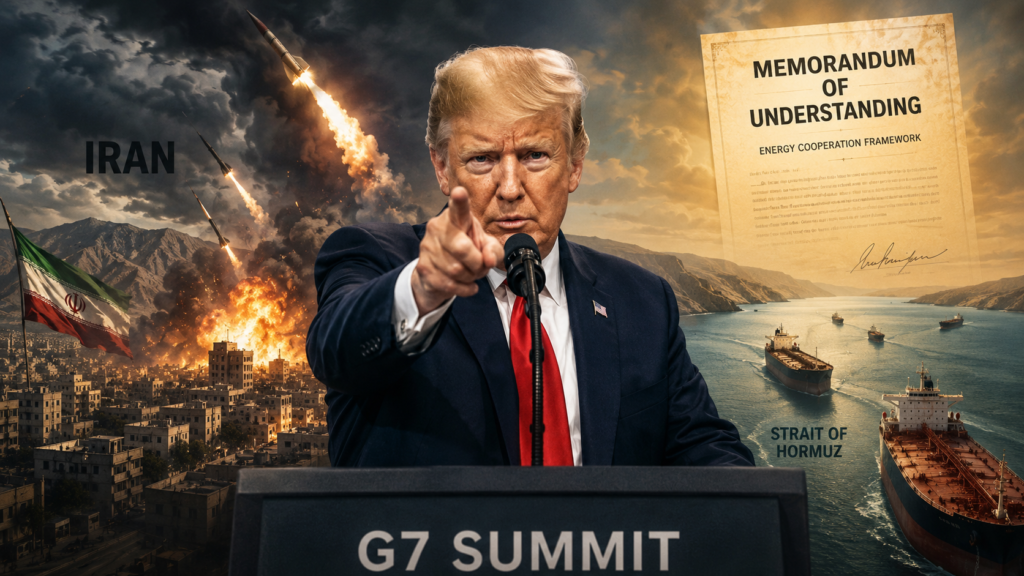
What exactly did Donald Trump say when he drops big bombshell comments about Iran?
Donald Trump stated that the memorandum of understanding was not a final agreement and that the United States would resume military action, including dropping bombs, if Iran failed to behave or if he judged the arrangement unsatisfactory. The remarks were made during a meeting with the Egyptian president at the G7 summit and emphasized that compliance would be closely watched.
How does the memorandum of understanding differ from a full peace treaty?
The document functions as an interim framework that halts hostilities, addresses immediate shipping concerns, and creates a defined period for negotiating a more comprehensive final deal. It does not resolve all outstanding issues on nuclear programs, missiles, or sanctions in permanent form. Provisions for economic benefits are largely contingent on successful further negotiations.
What impact did Donald Trump drops big bombshell rhetoric have on oil markets?
Oil prices moved toward three-month lows as traders anticipated reduced risk of prolonged disruption to Gulf energy flows. The president publicly linked market performance to the success of the diplomatic track and predicted further declines if stability held. Markets remain sensitive to any signs of renewed tension.
Is the threat of resumed bombing considered credible by analysts?
Many specialists treat the warning as credible because of the earlier military campaign’s demonstrated capabilities and the administration’s consistent emphasis on results over process. Maintaining readiness requires ongoing investment in munitions and force posture, factors that both supporters and critics continue to monitor.
What happens if the 60-day negotiation window ends without a final agreement?
The memorandum allows for extension by mutual consent. Without progress or extension, the parties would face decisions about whether to maintain the ceasefire terms, return to previous levels of pressure, or pursue alternative diplomatic paths. The president’s public statements indicate that American options would remain open.
How does this episode fit into Donald Trump’s broader foreign policy style?
The combination of demonstrated military action, rapid negotiation, and public retention of coercive tools aligns with previous patterns of using surprise and pressure to reshape negotiating dynamics. Outcomes are judged by tangible changes in adversary behavior and advances in American interests rather than by traditional diplomatic metrics alone.
Conclusion
The episode in which Donald Trump drops big bombshell language about the Iran memorandum captures the essence of a high-stakes, results-oriented approach to foreign policy. By pairing a negotiated pause in hostilities with unmistakable warnings about consequences, the administration has sought to maximize leverage during a critical window. Markets registered early relief, diplomats adjusted their calendars, and regional actors recalculated their positions. Whether the strategy produces lasting constraints on Iran’s nuclear and regional activities will become clearer as the negotiation period advances. For now, the world continues to watch closely whenever the president chooses to speak with such directness, recognizing that the words often signal genuine policy direction rather than mere rhetorical flourish. The coming weeks will test the durability of the framework and the effectiveness of the pressure that accompanies it.