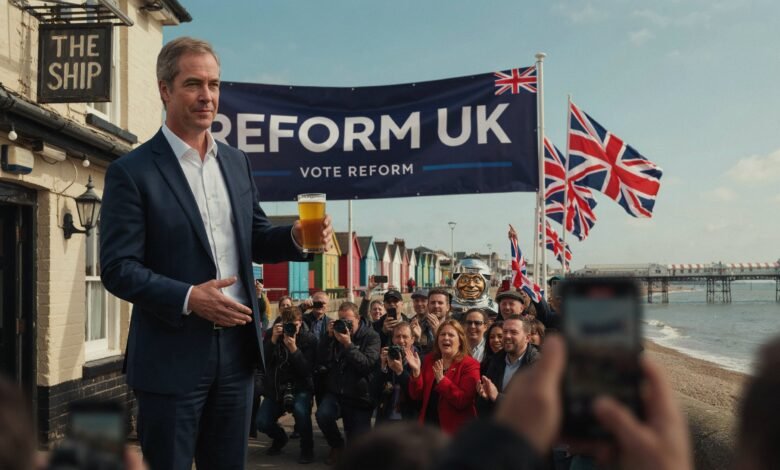
In a contest that mixed high-stakes politics with pure British eccentricity, Nigel Farage Wins Clacton By-Election in Major Political Test and returns to the House of Commons with a clearer personal mandate than before. The Reform UK leader, who had resigned his seat only weeks earlier, secured 22,239 votes on 13 August 2026 and left his nearest rival, the satirical Count Binface, trailing on 9,455. Turnout sat at roughly 44 percent in a race boycotted by every major Westminster party. What began as a calculated bid to reset the narrative around his finances ended as a strange, one-sided spectacle that still leaves serious questions unanswered.
Clacton-on-Sea has long served as a political weather vane for right-wing populism. Farage first captured the seat in the 2024 general election with 46.2 percent of the vote. This time the absence of Conservative, Labour, Liberal Democrat and Green candidates produced an inflated share of more than 63 percent. Supporters celebrated the result as proof that ordinary voters still back the man who drove Brexit. Critics called the entire exercise a costly distraction that did nothing to resolve the underlying investigations into undeclared gifts and support.
The story of how Nigel Farage Wins Clacton By-Election in Major Political Test is really the story of a politician who prefers the judgment of the ballot box to the judgment of parliamentary watchdogs. Whether that judgment settles anything remains the open question hanging over British politics in the late summer of 2026.
Background to the Resignation and Financial Scrutiny
The road to the by-election began with revelations about money. In the spring of 2026 journalists reported that Farage had received a £5 million gift from Christopher Harborne, a Thailand-based cryptocurrency entrepreneur and major Reform UK donor, shortly before the 2024 general election. Parliamentary rules require MPs to register benefits received in the twelve months before they enter the Commons if those benefits can reasonably be linked to their political activity. Farage did not register the payment.
He has offered several explanations. At different moments he described the sum as an unconditional gift, a reward for decades of Brexit campaigning, and money intended to fund personal security for the rest of his life. Harborne himself told one newspaper the money was meant to keep Farage safe. Separate reporting also highlighted undeclared support from George Cottrell, a long-time associate who had provided security, transport, staff and accommodation in the run-up to the 2024 campaign. Cottrell has a prior conviction related to fraud.
The Parliamentary Commissioner for Standards opened a formal inquiry. Banks had already flagged the Harborne payment to the National Crime Agency because they could not fully trace the funds. Farage insisted he had done nothing wrong and accused the process of being used as a political weapon by the establishment. By early July the pressure had become intense enough that he chose a dramatic response.
He resigned his seat, forcing a by-election, and immediately announced he would stand again. In his own words, the people of Clacton would be the only judges that mattered. The move was classic Farage: confrontational, theatrical and framed as a fight against an out-of-touch elite. It also placed a large administrative and financial burden on the local authority at a time when public services in coastal Essex already face strain.
Why Farage Called the By-Election
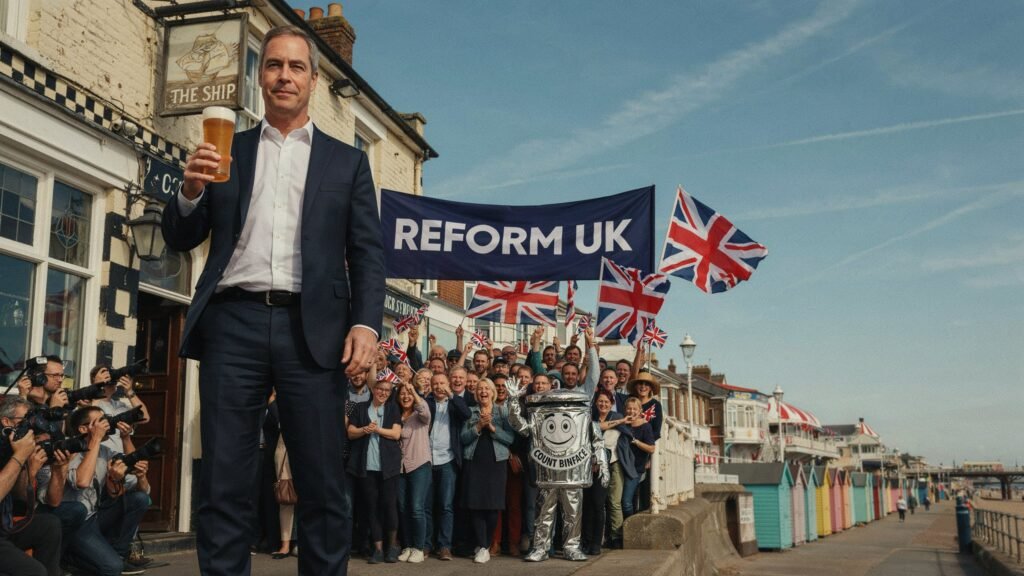
Farage presented the contest as a pure test of public confidence. He argued that parliamentary investigations and media scrutiny amounted to an establishment stitch-up and that only voters could deliver a legitimate verdict. By resigning and standing again he hoped to convert personal controversy into a fresh democratic endorsement.
The timing was deliberate. The standards inquiry was paused once he left the Commons, buying time. A decisive win, he believed, would strengthen his hand when the investigation resumed. It would also generate headlines that shifted attention away from the detailed questions about gifts, property purchases and the precise nature of the support he had received.
Local Reform activists largely backed the decision, though some privately worried that the spectacle would make Clacton look ridiculous. National party figures understood the risk but recognised that Farage’s personal brand remains the party’s strongest asset. Without him, Reform’s polling strength and media presence would diminish sharply. The by-election therefore became both a defensive manoeuvre and an opportunity to demonstrate continued grassroots loyalty.
The Boycott by Mainstream Parties
Labour, the Conservatives, the Liberal Democrats and the Greens all refused to field candidates. Their collective message was consistent: the by-election was a vanity exercise designed to distract from unresolved financial questions and an unnecessary cost to the public purse, estimated at around £250,000. Party spokespeople described it as a stunt rather than a genuine political contest.
The boycott left the field open to independents, minor parties and novelty candidates. Farage seized on the absence of serious opposition as further proof that the mainstream had abandoned voters. He claimed the parties were running scared of the people. Opponents replied that they simply refused to legitimise a process they considered cynical.
In practical terms the boycott transformed the election. Without credible alternative parties on the ballot, the race became a referendum on Farage himself rather than a conventional choice between programmes. That dynamic helped produce the elevated vote share that later allowed him to claim a ringing endorsement.
The Unusual Field of Candidates Including Count Binface
Thirty-four candidates eventually appeared on a ballot paper nearly a metre long. Most were independents or representatives of tiny organisations. Three stood for the Official Monster Raving Loony Party. One was Laurence Fox of the Reclaim Party. Another was a Rejoin EU candidate. The clear standout was Count Binface, the satirical creation of comedian Jon Harvey.
Binface, dressed in an elaborate bin-shaped costume and presenting himself as an intergalactic space warrior, has contested several previous elections. His manifesto for Clacton mixed jokes with pointed barbs: a ban on MPs who resign mid-term from standing in the resulting by-election, a refusal to accept £5 million gifts from crypto billionaires, a 99p price cap on 99 Flake ice creams, and a promise to spend more time in Clacton than in Washington. He raised significant crowdfunding and attracted national media attention far beyond any other challenger.
On the night Binface took more than a quarter of the vote. That performance exceeded the combined share of Labour, the Liberal Democrats and the Greens in 2024 and approached the Conservative total from that year. Many observers read the result as a protest against both Farage and the mainstream parties that had stayed away. Binface himself later declared that he had come first among the candidates who bothered to turn up for the declaration.
The sheer number of candidates created logistical headaches for Tendring District Council. Spoiled ballots numbered 280. Most of the fringe candidates lost their deposits. The spectacle reinforced the sense that the contest had drifted into political theatre.
Campaign Dynamics in Clacton
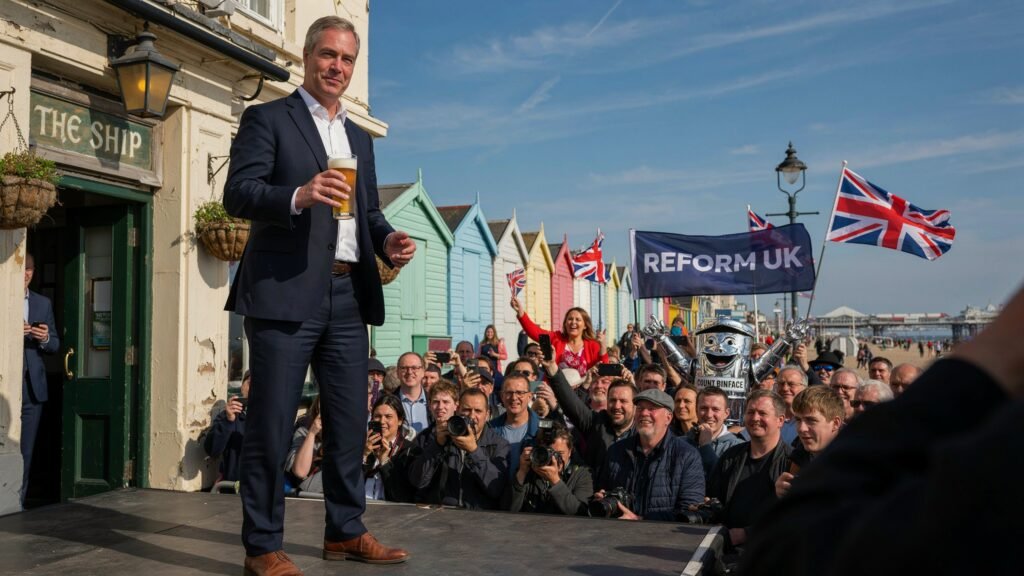
Clacton is a coastal constituency with deep Brexit roots and high levels of economic deprivation in some wards. Farage’s 2024 victory had already shown that Reform messaging on immigration, sovereignty and distrust of Westminster resonates strongly. The by-election campaign was shorter and less conventional. Farage held events that mixed pub visits with rallies. Supporters turned out to hear him frame the vote as a direct challenge to the political class.
Local issues such as housing, jobs, coastal erosion and the state of the high street still featured in conversations on the doorstep, yet the national story of money and resignation dominated coverage. Some residents expressed irritation that their town had become a national punchline. Others welcomed the attention and the chance to deliver another clear message of support for Farage.
Count Binface ran a deliberately light-hearted campaign that still managed to land serious points about accountability and the cost of the election. His presence gave journalists an easy visual and a ready-made narrative of Farage versus the bin man. Reform voters largely treated the novelty candidates as background noise.
Polling Day and the Results
Voters went to the polls on Thursday 13 August under clear skies. Early indications suggested solid Reform turnout in core areas. When the count concluded in the early hours of Friday, the figures confirmed what most expected.
| Candidate | Party | Votes | Vote Share |
|---|---|---|---|
| Nigel Farage | Reform UK | 22,239 | 63.34% |
| Count Binface | Count Binface Party | 9,455 | 26.93% |
| John Stevens | Rejoin EU | 492 | 1.40% |
| Tony Francis | Independent | 432 | 1.23% |
| Pamela Walford | Independent | 371 | 1.06% |
| Laurence Fox | Reclaim | 347 | 0.99% |
| William Clouston | Social Democratic Party | 256 | 0.73% |
| Others (combined) | Various | ~1,500 | ~4.3% |
Farage’s total exceeded his 2024 figure by just over a thousand votes even on a lower turnout. His majority rose from 8,405 to 12,784. The result delivered the headline he wanted: Nigel Farage Wins Clacton By-Election in Major Political Test and returns with an increased personal mandate.
Farage’s Reaction and Absence from the Count
Farage chose not to attend the formal declaration at Clacton Leisure Centre. He told supporters he had been warned of an organised campaign to disrupt and degrade the result and that he refused to stand on stage and be “demeaned and humiliated by nobodies.” Essex Police stated that the decision to attend or not was for individual candidates and their security teams; the force maintained a robust operation but did not confirm it had advised Farage to stay away.
Instead he addressed a Reform event overnight and claimed a “convincing, overwhelming win.” He argued that Clacton voters had stuck two fingers up at the entire political establishment. A planned major speech the following morning was cancelled. The absence from the count itself became another story, with critics arguing it showed a reluctance to face even the limited opposition that had bothered to turn up Midnightvinex.
One of the more memorable lines came from Binface after the result: “I came first in the Clacton by-election! Of the candidates who bothered to turn up for the results.” The jab captured the surreal atmosphere that had surrounded the entire contest.
Implications for Reform UK and UK Politics
The immediate political consequence is that Farage returns to the Commons with a stronger local mandate and a ready-made narrative of popular endorsement. Reform UK can claim that even under intense media and parliamentary pressure its leader remains popular in a key seat. That helps morale inside a party that has grown rapidly since 2024 and continues to challenge the traditional two-party system.
At the same time the result does little to resolve the structural questions facing Reform. The party still relies heavily on Farage’s personal appeal. The financial investigations resume now that he is once again an MP. If the standards commissioner ultimately finds a serious breach, a suspension long enough to trigger a recall petition remains possible. In that scenario the Conservatives have already signalled they would contest a further by-election.
Nationally the contest reinforces the sense of a fragmented political landscape. Mainstream parties’ refusal to participate left a vacuum filled by satire and protest. Whether that vacuum strengthens or weakens democratic accountability is already the subject of lively argument among commentators.
What This Means for Scrutiny of Farage’s Finances
The by-election does not erase the original concerns. The parliamentary inquiry into the Harborne gift has been formally reopened. Questions about the Cottrell support and the broader pattern of undeclared benefits remain live. Farage continues to insist he has broken no rules and that the process is politicised. His critics maintain that transparency rules exist for a reason and that large undisclosed gifts from wealthy individuals create at least the appearance of potential influence.
Public opinion on the issue is divided along familiar lines. Supporters accept Farage’s explanations and view the investigations as establishment revenge for Brexit and for Reform’s challenge to the old parties. Opponents see a serious transparency failure that would have been treated more severely in the case of almost any other politician. The ballot-box verdict in Clacton does not settle that dispute; it merely postpones the next chapter.
Local Impact on Clacton Residents
For people living in Clacton the by-election brought a mix of pride, irritation and resignation. Some residents enjoyed the national spotlight and the chance to reaffirm support for their MP. Others resented the cost to the local taxpayer and the impression that their town had been turned into a stage for one man’s political theatre. Business owners reported a temporary boost from media and campaign activity, yet longer-term concerns about deprivation, seasonal employment and coastal infrastructure remain unchanged.
The unusually long ballot paper and the presence of dozens of candidates who had little connection to the area left some voters feeling the process had become farcical. Still, the solid Reform turnout showed that core support for Farage’s brand of politics remains robust. Whether that support will translate into sustained attention to local issues now that he is back in Westminster is a question residents will continue to ask.
Historical Context of Clacton Elections
Clacton’s electoral history helps explain why the seat became the stage for this particular drama. For years it was a safe Conservative constituency. In 2014 Douglas Carswell defected from the Conservatives to UKIP under Farage’s leadership and held the seat. After Carswell left UKIP the Conservatives regained control until Farage’s 2024 breakthrough. The area’s strong Leave vote in the 2016 referendum and its demographic profile have made it fertile ground for parties that emphasise national sovereignty, controlled immigration and scepticism toward metropolitan elites.
The 2026 by-election fits a longer pattern of Clacton serving as a testing ground for populist challenges to the political mainstream. Farage’s decision to force the contest and then win it handsomely continues that tradition even as the surrounding circumstances remain highly unusual.
Broader Lessons from This Political Test
The episode offers several lessons. First, personal political brands still matter enormously in British politics. Farage’s ability to mobilise supporters and dominate the narrative even under adverse conditions remains striking. Second, the willingness of major parties to sit out a contest creates space for novelty and protest candidates that can distort the result and complicate claims of a pure popular mandate. Third, financial transparency rules and the mechanisms for enforcing them continue to generate friction when they collide with high-profile politicians who reject the legitimacy of the process.
Nigel Farage Wins Clacton By-Election in Major Political Test, yet the underlying tensions that produced the contest have not disappeared. The result strengthens his short-term position and gives Reform UK a symbolic victory. It does not, however, close the chapter on the questions about money, disclosure and accountability that prompted his resignation in the first place. Those questions will travel with him back to Westminster when Parliament returns from its summer recess.
Conclusion
The Clacton by-election of August 2026 will be remembered as one of the stranger episodes in recent British political history. A major party leader resigned under financial pressure, triggered a costly special election, faced a field dominated by independents and a man in a bin costume, and then won convincingly while skipping the declaration. Supporters see a triumphant reaffirmation of popular will. Critics see an expensive stunt that changed little of substance.
What is clear is that Nigel Farage remains a potent force capable of shaping the national conversation on his own terms. Whether the renewed mandate he secured will help him weather the resumed investigations, or whether those investigations will eventually produce further electoral tests, is the story that continues. For now, the voters of Clacton have delivered their verdict, and the Reform UK leader returns to Parliament with a larger majority and the same unresolved questions trailing behind him.
What exactly triggered the Clacton by-election that led to Nigel Farage Wins Clacton By-Election in Major Political Test?
Nigel Farage resigned his seat in July 2026 after months of intense scrutiny over an undeclared £5 million gift from cryptocurrency entrepreneur Christopher Harborne and additional undeclared support from associate George Cottrell. He framed the resignation as a decision to let the people of Clacton judge him rather than parliamentary investigators or the media. The resulting by-election became the vehicle for that judgment.
How significant was Count Binface’s performance when Nigel Farage Wins Clacton By-Election in Major Political Test?
Count Binface secured 9,455 votes, more than a quarter of the total and far higher than any previous result for the satirical candidate. His share exceeded the combined 2024 totals of several mainstream parties in the seat and turned him into the de facto main challenger in a race the big parties had boycotted. The performance highlighted both the protest vote and the unusual nature of the contest.
Did the result of Nigel Farage Wins Clacton By-Election in Major Political Test end the financial investigations?
No. The parliamentary standards inquiry into the Harborne gift was paused while Farage was not an MP and was formally reopened once he was re-elected. Separate questions about other forms of support and related reporting to the National Crime Agency also remain live. The ballot-box win strengthens Farage’s political position but does not resolve the underlying regulatory process.
Why did the major parties refuse to contest the seat in which Nigel Farage Wins Clacton By-Election in Major Political Test?
Labour, the Conservatives, the Liberal Democrats and the Greens all described the by-election as a vanity stunt and an unnecessary expense for taxpayers. They argued that participating would legitimise a process designed primarily to distract from unresolved financial questions. Their absence left the field to independents, minor parties and novelty candidates.
What happens next after Nigel Farage Wins Clacton By-Election in Major Political Test?
Farage is expected to be sworn in when Parliament returns from summer recess. The standards investigation continues. If a serious breach is found and a lengthy suspension imposed, a recall petition and potentially another by-election could follow. In the meantime Reform UK will seek to capitalise on the result while Farage’s critics continue to press the transparency issues that started the entire sequence of events.