Encountering unexplained errors while coding or running applications can halt progress and create frustration, especially when the message involves something as obscure as the 418dsg7 python issue. This particular error often surfaces in environments where Python scripts interact with web services, local caches, authentication systems, or external dependencies. Developers and system administrators report seeing it during API calls, data synchronization tasks, or when applications attempt to refresh tokens and process responses. The combination of the identifier with Python points to scenarios where the language’s flexibility meets real-world system constraints, such as network latency, corrupted state, or mismatched configurations.
What makes the 418dsg7 python challenge unique is its non-standard nature. It does not appear in official Python documentation or common HTTP status lists in the same way a standard exception might. Instead, it frequently acts as a composite or vendor-specific label that packages several underlying problems into one readable tag for logging and dashboards. Understanding this helps shift the focus from panic to methodical investigation. In practice, the error tends to appear when Python code relies on short-lived credentials, local storage that drifts from server state, or timed-out external calls. Addressing it requires a blend of quick triage steps and deeper inspection of how Python handles requests, sessions, and resources.
The good news is that Python itself provides excellent tools for diagnosing and mitigating such issues. From the requests library and built-in logging modules to more advanced options like asyncio for concurrent operations, the language equips developers to isolate root causes efficiently. This guide walks through the full landscape of the problem in a practical, conversational way so you can move past the interruption and build more resilient code.
Exploring the Nature of the 418dsg7 Python Phenomenon
The 418dsg7 python error typically manifests as a failure signal in application logs or user-facing messages when a process cannot complete its intended action. Unlike pure language exceptions such as TypeError or ValueError, this one often originates at the boundary between Python code and external systems. Think of a script that fetches data from a remote API, authenticates with a token, and then processes the response. If the token has expired mid-request or the local cache holds inconsistent data, the system may surface the 418dsg7 python tag rather than a more descriptive message.
Many teams adopt custom error namespaces for observability. The “418” portion can mislead people into recalling the playful HTTP 418 “I’m a teapot” status, yet here it serves as part of a proprietary identifier. The full string functions as a shorthand that groups related failures: authentication problems, state corruption, proxy misconfigurations, or dependency delays. In Python projects this becomes especially visible in web frameworks, background workers, or CLI tools that maintain persistent sessions.
Observing the error in the wild reveals patterns. Login might succeed while subsequent data loads fail partially. Background jobs can stall for tens of seconds before emitting the message. Logs frequently show token-refresh attempts immediately beforehand. Recognizing these symptoms early allows developers to gather the right context—request IDs, timestamps, and environment details—before diving into code changes.

Common Triggers Behind the 418dsg7 Python Issue
Several recurring conditions tend to produce the 418dsg7 python error. One frequent culprit involves session tokens or JWTs that expire while a long-running Python operation is still in flight. Python scripts that perform sequential API calls without proper refresh logic can hit this wall. Clock drift on the local machine exacerbates the problem because signature validation windows are often narrow.
Local cache or state corruption ranks high as well. Python applications frequently store intermediate results, feature flags, or schema snapshots on disk or in memory. When these become out of sync with the server—perhaps after an interrupted write or a version mismatch—subsequent operations fail and surface the composite error. Reverse-proxy or gateway settings introduce another layer. Header stripping, incorrect upstream health checks, or sticky-session problems can turn legitimate upstream responses into opaque client-side failures labeled 418dsg7 python.
Dependency timeouts and rate limiting complete the usual suspects. A Python service that calls multiple external endpoints may exceed time budgets or hit soft throttles. Rather than exposing provider-specific details, the client collapses the outcome into the familiar tag. Network middleboxes, VPNs, and corporate proxies can further complicate the picture by interfering with TLS handshakes or required headers.
Diagnosing the Problem with Python Tools and Techniques
Python’s standard library and ecosystem make diagnosis surprisingly approachable. Begin by enabling detailed logging. The logging module can capture request headers, response codes, and exception traces at the exact moment the 418dsg7 python signal appears. Adding correlation IDs to every outgoing call helps later reconstruct the full path through gateways and upstream services.
For network-level insight, the requests library combined with verbose flags or the http.client debug level reveals handshake details and header transformations. When working with asynchronous code, asyncio and aiohttp provide timing instrumentation that highlights which dependency crossed the timeout threshold. System-level checks remain essential too. Python scripts can query the local clock via the time module and compare it against a reliable NTP source to detect skew.
Cache inspection often yields quick wins. Python’s pathlib and tempfile utilities let you examine and, if necessary, purge application-specific cache directories. For browser-based or desktop clients that embed Python components, clearing site data or application storage folders frequently clears the path for a clean retry. Collecting a minimal reproducible case—timestamp, public IP, request ID, and recent environment changes—prepares you for either self-resolution or productive support escalation.
Practical Fixes That Resolve the 418dsg7 Python Error
Start with the least invasive actions. A clean sign-out followed by credential refresh often restores functionality when tokens are the issue. In Python terms this means discarding any stored access and refresh tokens, then initiating a fresh authentication flow. Clearing local state comes next. Delete or rename the relevant cache directories and restart the process so the application rebuilds its working set from authoritative sources.
Updating the client application and its dependencies reduces version-skew problems. Python’s package managers make this straightforward: ensure the runtime, requests, and any framework packages sit at current stable versions. Network adjustments can also help. Temporarily disabling VPNs or custom proxies isolates whether middleboxes contribute to the failure. On systems where time synchronization matters, force an NTP resync and verify the clock stays accurate after sleep or hibernation cycles.
When concurrency plays a role, reduce parallelism. Lower the number of simultaneous workers or batch sizes in data-sync scripts. Exponential backoff with jitter, easily implemented in Python, prevents hammering rate-limited endpoints. If the error persists across devices and networks, the problem likely sits on the service side and waiting for recovery becomes the pragmatic choice.
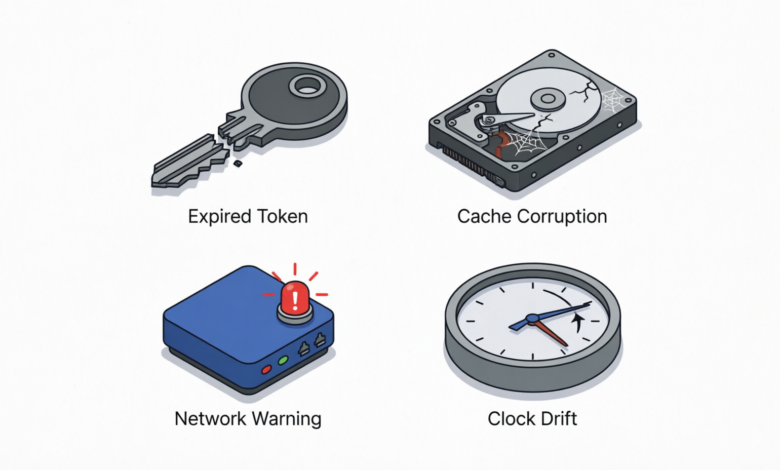
“Treat composite error tags like 418dsg7 as signals rather than final verdicts. They point you toward the four usual suspects—auth, cache, network, and time—and give you a clear starting map for investigation.”
Prevention Strategies for Long-Term Stability
Building resilient Python applications means designing around the conditions that produce the 418dsg7 python error. Prefer short-lived tokens paired with robust refresh logic that handles clock skew gracefully. Version every client-side cache and invalidate entries when server schemas change. Atomic writes with checksum verification prevent partial corruption that later triggers failures.
On the infrastructure side, keep proxy and gateway configurations under version control and validate them in continuous-integration pipelines. Publish explicit rate-limit information to clients so they can adapt rather than guess. Monitor token-refresh success rates, cache-eviction reasons, and per-dependency latency so emerging patterns surface before users notice them.
End users benefit from simple habits as well. Keep the operating system and applications updated, avoid unnecessary stacked network layers, and periodically clear caches when switching between environments. Reliable time sources and verification after long idle periods further reduce the chance of time-sensitive failures.
Advanced Troubleshooting and Observability Practices
When basic fixes fall short, deeper observability becomes essential. Structure logs so that every occurrence of the 418dsg7 python identifier maps back to a concrete cause category. Attach correlation identifiers that travel from the client through gateways to upstream services. Track metrics around token lifetime, cache hit ratios, and dependency response times.
Circuit breakers and carefully tuned timeouts protect the rest of the system when one dependency misbehaves. Prefer returning clear 429 or 503 semantics to clients whenever possible rather than collapsing everything into a single opaque tag. On the security front, enforce strict time synchronization across servers and clients and keep refresh endpoints highly available.
Python’s rich ecosystem supports these practices. Libraries for structured logging, metrics collection, and distributed tracing integrate cleanly into both monolithic and microservice architectures. Regular review of error taxonomies ensures that composite labels remain useful rather than becoming black boxes.
Real-World Scenarios and Lessons Learned
Consider a data-processing pipeline written in Python that periodically pulls records from a cloud service. After a long weekend the local clock has drifted, tokens expire mid-batch, and the job surfaces the 418dsg7 python error. Restoring time sync and implementing proactive token refresh eliminates the recurring interruption. In another case a web application behind a reverse proxy strips an important authentication header; the client receives an unexpected response and labels it 418dsg7 python. Restoring the header and adding configuration linting prevents recurrence.
Desktop tools that embed Python interpreters sometimes store large local caches. An interrupted update leaves the cache inconsistent; subsequent launches fail with the familiar message. Atomic cache replacement and versioned storage directories solve the problem at the architectural level. These examples illustrate that the error, while inconvenient, almost always points to solvable configuration or design issues rather than fundamental language limitations.
| Cause Category | Typical Symptoms | Primary Mitigation Approach |
|---|---|---|
| Expired tokens | Auth succeeds then data fails | Clean refresh flow and clock checks |
| Cache corruption | Partial loads or endless loops | Purge and version local state |
| Proxy misconfiguration | Sporadic stalls after gateway hop | Validate headers and health checks |
| Dependency timeout | Long delays then generic failure | Tune timeouts and add backoff |
| Rate limiting | Burst failures during cold starts | Respect limits and reduce concurrency |
The table above summarizes the most frequent patterns observed across different Python-based systems. Mapping observed symptoms to these categories accelerates diagnosis and reduces the time spent chasing unrelated possibilities.

Integrating Best Practices into Daily Python Development
Everyday coding habits can dramatically lower the incidence of the 418dsg7 python error. Write authentication helpers that automatically refresh tokens before they expire and that surface clear diagnostics when refresh fails. Prefer server-driven configuration with short time-to-live values over long-lived local flags. Instrument every external call with timing and correlation data so that failures become self-documenting.
Code reviews offer another opportunity. Ask whether new network paths handle transient failures gracefully and whether local storage operations remain atomic. Automated tests that deliberately introduce clock skew, truncated cache files, or delayed responses catch many problems before they reach production. Continuous monitoring of the error’s frequency and associated metrics turns reactive firefighting into proactive improvement.
Teams that treat the identifier as a useful signal rather than an annoyance tend to ship more reliable software. They invest in clearer error taxonomies, better observability, and defensive coding patterns that absorb the inevitable variability of distributed systems.
Conclusion of the Article
Navigating the 418dsg7 python error ultimately strengthens both individual skills and system design. By recognizing it as a composite signal rather than a mysterious verdict, developers can apply a consistent sequence of triage, diagnosis, and remediation steps. Quick actions such as credential refresh, cache reset, and time synchronization resolve the majority of cases. Longer-term investments in versioned caches, robust token handling, structured logging, and configuration hygiene prevent the problem from recurring.
Python’s flexibility and rich tooling ecosystem make it especially well suited to both investigating and hardening against these failures. Whether the error appears in a simple script, a web application, or a complex data pipeline, the same principles apply: gather context, isolate the contributing factors, apply the least disruptive fix first, and then improve the surrounding architecture. With these practices in place, the once-frustrating 418dsg7 python message becomes just another manageable part of building software that works reliably in the real world.
What exactly does the 418dsg7 python error indicate?
The 418dsg7 python error functions as a custom or composite identifier rather than a standard language or HTTP status. It typically signals that a request or task could not complete because of problems such as expired authentication tokens, inconsistent local cache, proxy configuration issues, dependency timeouts, or clock skew. In Python applications the tag often appears when code interacts with external services or maintains persistent state. Treating it as a pointer to one of these common categories allows faster diagnosis than treating it as an unknown failure.
Can the 418dsg7 python problem be caused by malware?
No evidence links the 418dsg7 python identifier to malware or viruses. It arises from ordinary operational conditions such as authentication lifetime, cache consistency, network intermediaries, and time synchronization. Maintaining up-to-date security tools remains good practice, yet the error itself does not indicate a security compromise. Focus investigation on the usual technical causes rather than assuming malicious involvement.
How can I quickly check whether time skew is behind the 418dsg7 python error?
Compare the local system clock against a trusted external time source. In Python the time module can report the current local time while a simple network call retrieves authoritative time. Differences of more than a few seconds often break token validation or signed requests. Enabling automatic network time synchronization and forcing a resync after periods of sleep or hibernation usually eliminates this class of failure.
Does reinstalling the application always fix the 418dsg7 python issue?
Reinstallation can clear corrupted local state and outdated binaries, yet it is rarely the first or most efficient step. Many instances resolve after a clean authentication refresh, cache purge, or time correction. Attempt those lighter actions first. Reserve full reinstallation for cases where the installation itself appears damaged or when lighter remedies have already been exhausted.
What information should I collect before escalating a persistent 418dsg7 python error?
Gather the exact timestamp and timezone of the failure, the public IP address in use, any correlation or request identifier shown in the error dialog or logs, a clear sequence of steps that reproduces the problem, and notes about recent changes such as application updates, new network configurations, or environment switches. This package of details enables support teams or maintainers to investigate efficiently and often shortens resolution time dramatically.