
Many parents notice their child talks easily, reads well, and remembers facts like a walking encyclopedia, yet struggles with puzzles, sports, or reading a friend’s facial expression. That puzzling mix often points to non verbal learning disorder. This condition affects how the brain handles visual and spatial information while leaving verbal strengths largely intact. It can shape schoolwork, friendships, and everyday independence in ways that surprise even experienced teachers and doctors.
In the pages ahead you will find clear explanations of what non verbal learning disorder looks like across different ages, why it remains under-recognized, and practical steps that genuinely help. The goal is to give you solid knowledge without medical jargon so you can advocate effectively and support the person you care about.
What Exactly Is Non Verbal Learning Disorder
Non verbal learning disorder is a neurodevelopmental condition marked by significant difficulty processing nonverbal information, especially visual-spatial details, while verbal abilities stay average or above average. People with this profile often excel at speaking, reading, and memorizing spoken or written facts. At the same time they may find maps confusing, handwriting exhausting, and social cues hard to read.
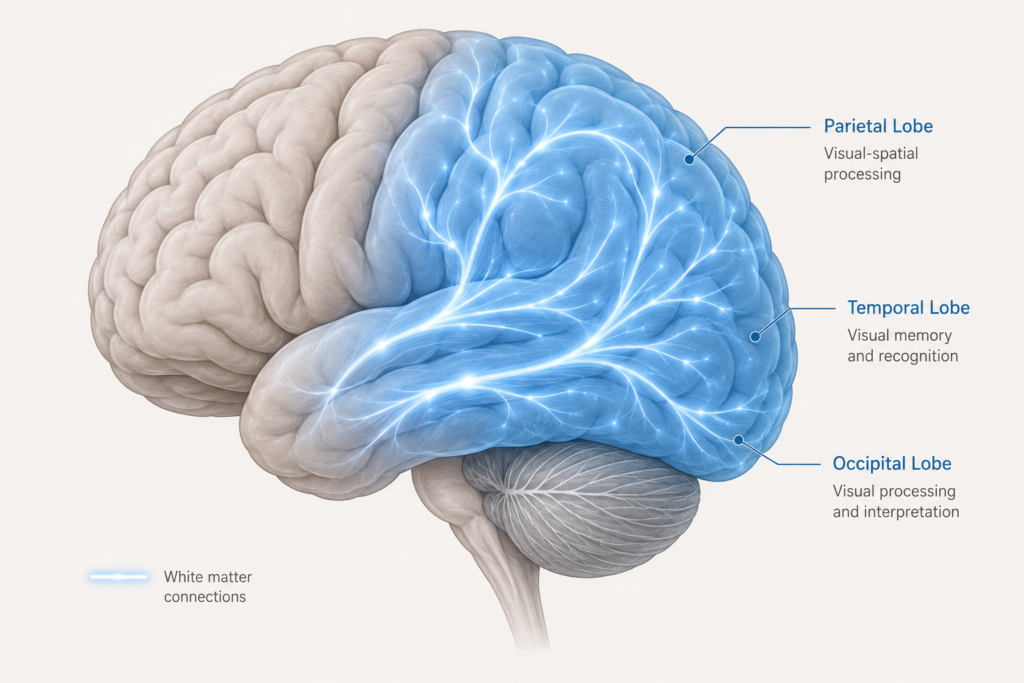
Researchers link the pattern to differences in the right hemisphere of the brain and its white-matter connections. These pathways help us judge distance, organize visual details, and interpret body language. When those networks work less efficiently, everyday tasks that most people perform automatically become effortful. The condition is lifelong, yet many individuals develop effective strategies and lead fulfilling lives once they understand their unique wiring.
Because non verbal learning disorder is not listed as a formal diagnosis in the current DSM-5, clinicians sometimes describe it as a specific learning disorder with impairment in mathematics or as an unspecified neurodevelopmental disorder. Advocacy groups and researchers continue to push for clearer recognition, often proposing the name developmental visual-spatial disorder to highlight the core challenge.
Common Signs That Appear at Different Ages
Early clues often surface in preschool. A child may prefer talking about toys rather than building with blocks, avoid climbing structures, or struggle to button clothes and use scissors. Fine-motor tasks feel clumsy, and the child might bump into furniture more often than peers. Strong verbal skills can mask these motor and spatial delays, so adults sometimes assume the child is simply “not sporty.”
By elementary school the picture becomes clearer. Handwriting looks messy or labored. Math concepts that involve spatial relationships—fractions, geometry, place value—prove stubborn. Reading comprehension may lag even when decoding is strong, because the child focuses on individual words rather than the overall story structure. Socially, the child might miss sarcasm, stand too close or too far, or misread facial expressions, leading to awkward interactions. Organization of backpacks, desks, and multi-step assignments frequently falls apart.
In middle and high school the demands intensify. Essays that require synthesizing ideas feel overwhelming. Word problems in math become major roadblocks. Navigating a large school campus or interpreting a complicated schedule can create daily stress. Anxiety often rises as academic and social gaps grow more noticeable. Many adolescents with non verbal learning disorder become experts at using their verbal strengths to compensate—talking their way through tasks—yet still feel exhausted by the constant effort.
How Non Verbal Learning Disorder Differs from Autism and ADHD
Overlap exists, yet important distinctions help guide accurate support. Children on the autism spectrum often show differences in social motivation, restricted interests, and sensory sensitivities. Those with non verbal learning disorder usually want friendships and can engage in reciprocal conversation; their social difficulties stem more from missing nonverbal signals than from a fundamental difference in social drive. Repetitive behaviors and intense special interests are not core features of non verbal learning disorder.
ADHD shares challenges with attention, organization, and executive function. However, motor coordination problems and consistent visual-spatial weaknesses appear more central in non verbal learning disorder. A child with ADHD may perform well on spatial tasks when focused, while a child with non verbal learning disorder struggles with those tasks even under ideal conditions. Comprehensive testing that compares verbal and nonverbal abilities helps clarify the picture. Some individuals meet criteria for more than one condition, so a thorough evaluation remains essential.
Exploring Possible Causes and Risk Factors
Scientists have not identified a single cause. Current evidence points to differences in right-hemisphere white-matter pathways that support visual-spatial processing and inter-hemispheric communication. These differences appear early in development and may have genetic components, since the pattern sometimes runs in families.
Prenatal and perinatal factors occasionally appear in histories—maternal illness, premature birth, or low birth weight—but many children with non verbal learning disorder have unremarkable early medical records. The condition is not caused by parenting style, lack of stimulation, or emotional trauma. Understanding its neurological basis helps reduce misplaced guilt and directs energy toward effective interventions.
The Challenges of Getting an Accurate Diagnosis
Because non verbal learning disorder lacks official DSM-5 criteria, diagnosis relies on clinical judgment informed by detailed history and neuropsychological testing. Evaluators look for a meaningful gap between strong verbal intelligence and weaker nonverbal, visual-spatial, and motor scores. They also assess academic skills, social functioning, and daily living abilities. Input from parents, teachers, and the individual themselves paints a fuller picture.
Testing often includes measures of visual-spatial construction, fine-motor coordination, mathematical reasoning, and social perception. A discrepancy of ten or more points between verbal and performance IQ has traditionally been noted, though modern assessments examine specific subtests rather than relying solely on that split. Ruling out other explanations—vision or hearing problems, pure motor disorders, or primary language impairments—forms part of a careful differential diagnosis. Many families report that the process takes time and multiple specialists, yet a clear profile opens the door to targeted support.
Everyday Impact at Home, School, and Work
At home, simple routines can become complicated. Tying shoes, packing a lunch, or navigating an unfamiliar store layout may require extra time and verbal reminders. Children often prefer structured, predictable environments and may resist novel activities that involve spatial or motor demands. Parents sometimes notice that the child can describe a route in words yet still get lost when following it.
School presents layered challenges. Strong reading and vocabulary skills can lead teachers to expect equally strong performance in every subject. When visual-spatial demands rise—geometry, graphing, note-taking from a board, or group projects that require spatial planning—frustration appears. Socially, missed cues can leave the student feeling left out even though they long for connection. Executive-function difficulties compound the academic load: planning long-term projects, managing time, and organizing materials demand extra scaffolding.
Adults with non verbal learning disorder often describe similar patterns in the workplace. Jobs that emphasize verbal communication and sequential reasoning may feel comfortable, while roles requiring rapid spatial judgment, map reading, or interpreting subtle interpersonal signals create ongoing stress. Many develop successful careers by leaning into verbal strengths and using technology or workplace accommodations for spatial and organizational tasks.
Practical Strategies and Support Options That Help
Occupational therapy addresses fine- and gross-motor skills, handwriting, and daily living tasks. Therapists break activities into verbal steps and practice visual-spatial skills in graded ways. Physical therapy can improve coordination and body awareness. Social-skills groups that explicitly teach facial expressions, personal space, and conversational timing give concrete tools for peer interactions.
Cognitive-behavioral approaches help manage the anxiety that frequently accompanies repeated social or academic setbacks. Educational accommodations—extended time, verbal instructions paired with visual supports, preferential seating, and alternative ways to demonstrate knowledge—reduce unnecessary barriers. Teachers can present material in sequential, language-based formats and check for understanding of the “big picture” rather than isolated details.
Technology offers powerful supports: speech-to-text for writing, digital organizers, GPS for navigation, and apps that break multi-step tasks into checklists. At home, consistent routines, visual schedules paired with verbal explanations, and practice with maps or puzzles in low-pressure settings build skills over time. The most effective plans remain individualized; what works for one person may need adjustment for another.
Supporting Strengths While Addressing Challenges
People with non verbal learning disorder frequently possess rich vocabularies, excellent auditory memory, and strong logical reasoning when information is presented verbally. These strengths become powerful assets when recognized and nurtured. Encouraging debate, storytelling, reading aloud, and verbal problem-solving builds confidence. Many excel in subjects that reward verbal fluency—literature, history, languages, or certain areas of law and counseling.
Balancing support means celebrating verbal gifts while patiently scaffolding the nonverbal areas. Avoid assuming that strong language equals strong overall ability; instead, observe where effort is high relative to outcome. Provide extra processing time for visual material and offer verbal mediation—“Let’s talk through the steps of this diagram.” Over years, many individuals internalize these strategies and become skilled self-advocates.
Looking at the Bigger Picture: Prevalence and Recognition
Studies estimate that non verbal learning disorder affects roughly three to four percent of children and adolescents in North American samples. When applied to population figures, that translates into millions of young people. Yet because the condition remains outside formal diagnostic manuals, many go unidentified or receive alternative labels that only partially capture their needs.
Growing research interest, including proposals to reframe the profile as a developmental visual-spatial disorder, signals progress. Parent advocacy organizations continue to raise awareness among educators and clinicians. Greater recognition promises more consistent identification, better-designed interventions, and reduced stigma for those whose challenges do not fit neat diagnostic boxes.

Living Successfully as an Adult with the Condition
Adults often report that understanding their own profile brings relief. Career choices that emphasize verbal strengths—writing, teaching, counseling, sales, or analysis—frequently prove satisfying. Workplace strategies such as written agendas, clear verbal instructions, and collaborative spatial tasks can smooth daily functioning. Social relationships improve when individuals learn to ask clarifying questions about nonverbal signals and to explain their own processing style to trusted friends or partners.
Self-advocacy becomes a key skill. Knowing when to request extra time, a quiet workspace, or a verbal summary of visual material reduces unnecessary stress. Many adults also find value in mindfulness practices and physical activity tailored to their motor profile. The condition does not disappear, yet its impact can diminish dramatically with insight, strategies, and supportive environments.
A Helpful Comparison of Related Profiles
| Area of Functioning | Non Verbal Learning Disorder | Autism Spectrum | ADHD |
|---|---|---|---|
| Verbal skills | Usually strong or superior | Variable; can range widely | Typically intact |
| Visual-spatial processing | Core area of difficulty | Variable; not defining | Usually relative strength |
| Social motivation | Generally present; difficulty reading cues | Often differences in social drive | Usually typical |
| Motor coordination | Frequently impaired | Variable | Usually typical or better |
| Repetitive behaviors | Not a core feature | Often present | Not characteristic |
| Attention regulation | Can be secondary challenge | Variable | Core feature |
This table highlights patterns rather than rigid rules. Individual presentations vary, and co-occurrence is possible. Professional evaluation remains the best route to clarity.
Insights from Those Who Understand the Journey
One experienced clinician observed, “Children with this profile often sound more mature than their peers because of their verbal gifts, yet they can feel lost in the nonverbal world that most of us navigate without thinking.”
A parent shared, “Once we stopped expecting our son to ‘just get’ spatial tasks and started giving him the verbal road map he needed, his confidence soared.”
An adult reflecting on school years said, “I could explain any concept out loud, but putting the same idea into a diagram felt impossible. Knowing why made all the difference.”
These voices underscore a central truth: knowledge and tailored support transform daily experience.
Frequently Asked Questions
What is the main difference between non verbal learning disorder and a typical learning disability?
Most learning disabilities center on reading, writing, or math calculation. Non verbal learning disorder specifically involves difficulty with visual-spatial processing, motor coordination, and interpreting nonverbal social information while verbal skills remain relatively strong. The academic impact often appears most clearly in higher-level math, reading comprehension of complex texts, and written organization rather than basic decoding or spelling.
Can non verbal learning disorder be diagnosed in adults?
Yes. Although identification often occurs in childhood, many adults seek evaluation after years of unexplained struggles with organization, spatial tasks, or social nuances. A comprehensive neuropsychological assessment can still clarify the profile and guide workplace or personal strategies even later in life.
Does non verbal learning disorder improve with age?
Core visual-spatial differences tend to persist, yet people develop compensatory strategies that reduce everyday impact. Verbal strengths, explicit teaching of social and organizational skills, and environmental supports enable many individuals to achieve independence and success. Early understanding generally leads to smoother progress.
Are there medications specifically for non verbal learning disorder?
No medication targets the visual-spatial or motor aspects directly. When anxiety, attention difficulties, or mood concerns coexist, clinicians may prescribe treatments for those secondary issues. The primary approaches remain educational, therapeutic, and environmental rather than pharmacological.
How can teachers best support a student with non verbal learning disorder?
Provide clear verbal instructions alongside any visual material. Break multi-step tasks into sequenced language-based steps. Offer alternative ways to demonstrate knowledge—oral reports instead of purely visual projects when appropriate. Allow extra time for writing and organization. Explicitly teach social cues and organizational systems. Collaboration with occupational therapists and learning specialists multiplies the benefit.
Is non verbal learning disorder the same as dyspraxia or dyscalculia?
Overlap exists, yet the profiles are not identical. Dyspraxia focuses primarily on motor planning and coordination. Dyscalculia centers on number sense and mathematical reasoning. Non verbal learning disorder encompasses a broader pattern that includes visual-spatial, motor, social-perception, and executive-function challenges while preserving strong verbal abilities. Comprehensive assessment distinguishes the contributions of each.
Conclusion
Non verbal learning disorder shapes how a person experiences the world of space, movement, and unspoken social signals, yet it leaves intact a powerful capacity for language and reasoning. Recognition of this profile allows families, educators, and the individuals themselves to replace confusion with clarity and frustration with targeted support. Strengths in verbal expression become tools for navigating challenges. With understanding, practical strategies, and patience, people with non verbal learning disorder build meaningful relationships, succeed academically and professionally, and live lives defined by capability rather than limitation. The more widely this knowledge spreads, the more effectively we can open doors for every unique mind.

